New Delhi: The Indian Army is exploring an advanced battlefield protection system that could significantly enhance the survivability of its armored formations against modern drone warfare. The proposal involves integrating 10-kilowatt laser weapon systems onto frontline battle tanks such as the T-90 Bhishma and Arjun Mk1A.
The move comes amid growing global concern over the rising effectiveness of First-Person View (FPV) drones, loitering munitions, and coordinated drone swarm attacks against heavily armored vehicles.
Defence analysts believe the Indian Army’s interest in directed-energy protection systems has been strongly influenced by operational lessons emerging from the ongoing Russia-Ukraine War, where low-cost drones have repeatedly exposed vulnerabilities in conventional mechanized warfare.
In several battlefield incidents, small drones equipped with explosives have managed to strike sensitive sections of tanks, including turrets, engine compartments, and ammunition storage areas, causing severe damage despite heavy armor protection.
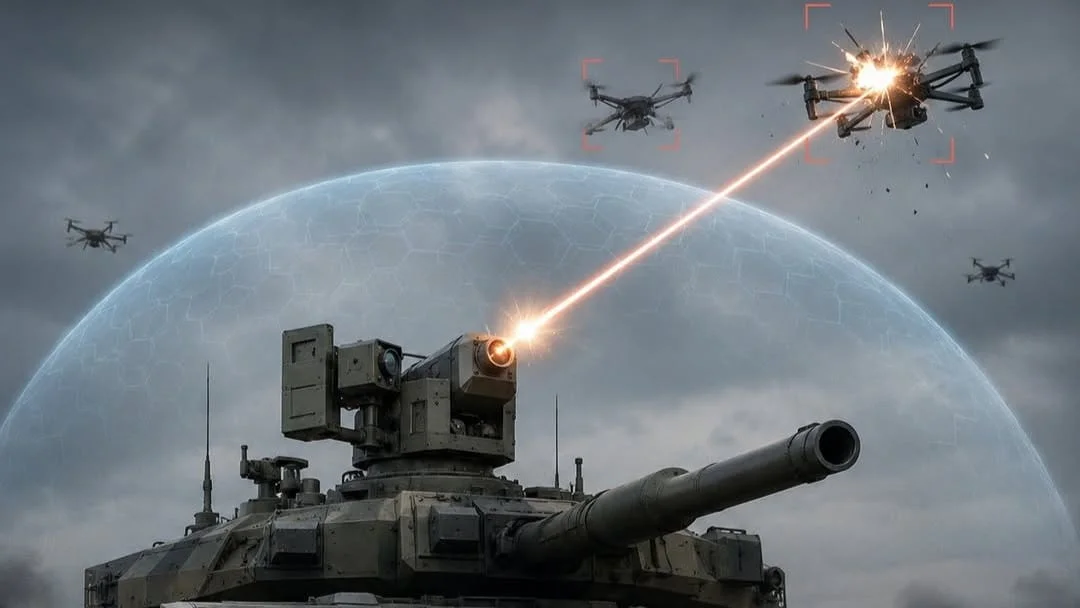
To address this evolving threat environment, the Army is reportedly examining a “shield tank” concept. Under this model, select tanks within a combat formation would carry laser-based counter-drone systems and automated close-in protection technologies capable of neutralising aerial threats before they reach friendly vehicles.
Military planners envision these specially equipped tanks functioning as mobile defence nodes for armored convoys, potentially providing protective coverage for formations consisting of 20 to 40 tanks moving in coordination during combat operations.
The proposed laser systems are expected to perform multiple functions, including blinding drone optics, disrupting guidance systems, damaging control electronics, or physically destroying propellers and structural components of low-flying unmanned aerial vehicles.
The initiative also reflects India’s accelerating progress in indigenous directed-energy weapons technology. Recently, the Defence Research and Development Organisation successfully demonstrated its 30 kW Mk-II(A) Directed Energy Weapon system, a major technological milestone that placed India among a select group of nations developing operational laser-based anti-drone capabilities.
Unlike traditional missile-based interceptors, laser weapons offer several strategic advantages. Directed-energy systems can engage multiple targets rapidly, require no conventional ammunition reloads, and have a comparatively low operational cost per engagement. As long as sufficient electrical power is available, laser systems can repeatedly fire at incoming threats almost instantaneously.


This makes them particularly attractive as a countermeasure against inexpensive commercial drones and swarm attacks that can overwhelm traditional air defence systems through sheer numbers.
However, integrating such advanced technology onto battle tanks presents major engineering and operational challenges.
Main battle tanks are designed to operate in extremely harsh conditions involving heavy vibration, dust, heat, shock, and uneven terrain. Maintaining the precise targeting stability required for laser weapons under combat movement remains technically demanding.
In addition, tanks were not originally designed to support high-energy weapons requiring sustained electrical output and advanced thermal management. Defence experts believe auxiliary power systems, upgraded battery architecture, and specialised cooling mechanisms may be necessary to support continuous laser operations in battlefield conditions.
Despite these hurdles, India’s pursuit of a mobile laser-based anti-drone shield reflects a broader global shift toward layered active protection systems for armored warfare.
Across the world, major military powers are increasingly investing in directed-energy technologies to ensure that tanks and mechanized formations remain viable on future battlefields shaped by drones, autonomous systems, and network-centric warfare.
If successfully developed and operationalised, the laser shield concept could become a major force multiplier for India’s armored corps and significantly strengthen battlefield survivability against emerging aerial threats.













 https://www.youtube.com/watch?si=RtToJsBhYBatUrym&v=mOuYNSdhjHA&feature=youtu.be